Buying your supplies at the right price is essential to building a profitable wax melt business. This guide explains when to buy retail, when to go wholesale, and how to get the best value from UK suppliers.
Understanding Pricing Tiers
Most UK wax melt suppliers operate on a tiered pricing structure. The more you buy, the lower your cost per unit. Understanding these tiers — and planning your orders around them — can dramatically improve your margins.
Example: Soy wax might cost £4.50/kg at 1kg, £3.80/kg at 5kg, and £3.20/kg at 25kg. If you're using 5kg per week, buying a 25kg bag every month saves you ~£30 per month — or £360 per year — on wax alone.
When to Buy Retail
Buying retail (small quantities, standard prices) makes sense when:
- You're a hobbyist making occasional batches
- You're testing a new wax, fragrance or supplier for the first time
- You need a specific item quickly without minimum order requirements
- Storage space is limited
When to Go Wholesale
Moving to wholesale purchasing is the right decision when:
- You're making consistent batches (at least weekly)
- You have storage space for 5–25kg bags of wax and bulk fragrance
- You've settled on a recipe and no longer need to test extensively
- You're selling products and need to maximise your profit margins
UK Suppliers with Wholesale Accounts
Several retailers in our directory offer dedicated wholesale pricing or accounts for small businesses:
- Candle Shack — industry-renowned for wholesale wax and fragrance with tiered pricing
- Craftovator — excellent bulk pricing on wax, fragrance and dyes
- Livemoor — particularly competitive on soy wax at bulk quantities
- The Soap Kitchen — great for makers who also produce soap and cosmetics
Calculating Your Cost Per Melt
Before deciding on your wholesale volume, calculate your true cost per melt. Include:
- Wax cost per gram (weight per melt × cost per kg ÷ 1000)
- Fragrance oil cost per gram (at your chosen % load)
- Colourant cost per melt
- Packaging cost per unit
- Labels, delivery, time
Most makers target a material cost of 20–30% of the retail selling price, leaving margin for time, overheads and profit.
Buying Fragrance Oils in Bulk
Fragrance oils are often the most expensive ingredient by weight. At retail, 100ml might cost £3–5. At 500ml, the cost per ml typically drops by 30–40%. At 1 litre or kilogram quantities from a specialist supplier, savings can be even greater — but always test at small scale before committing to a litre of an untested scent.
| Quantity | Typical Price/100ml | Best For |
|---|---|---|
| 10–30ml sample | £1.50–3.00 | Testing new scents |
| 100ml retail | £3.00–5.00 | Hobbyist use |
| 500ml | £2.00–3.50 | Regular makers |
| 1kg+ | £1.50–2.50 | Business production |
Recommended on Amazon
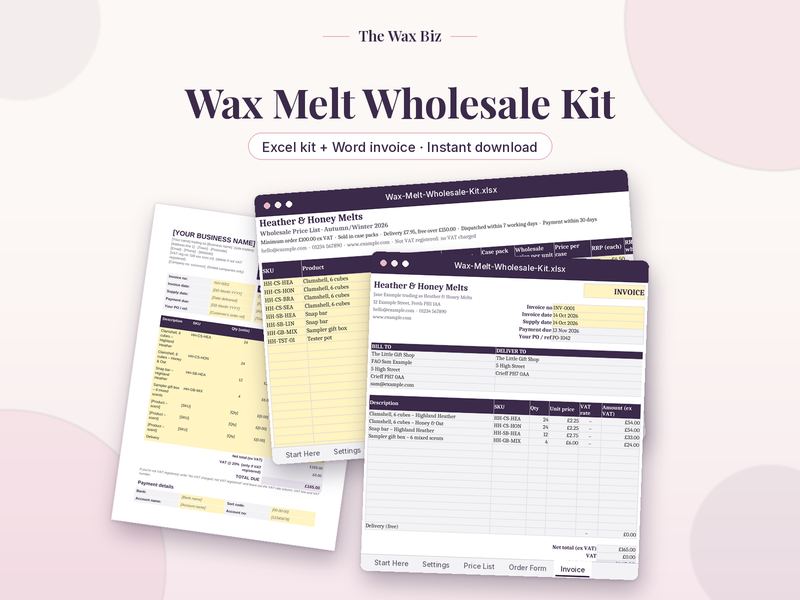 Selling to shops?Wholesale Kit · £6.50A line sheet, order form and auto-filling invoice for your first stockist.See it on Payhip →